
 ,

 ,
 ,

Context: Ownership includes being able to keep using things when the original hardware no longer works or is no longer made. Games are no exception. A different console should be a way to keep playing your existing collection, not a reason to buy the same games again.
The Analogue Mega Sg+ and Super Nt+ serve as examples here. This is not a purchase report or a hands-on hardware review; product specifications come from the manufacturer. At the time of writing, Analogue lists December 2026 for shipping.
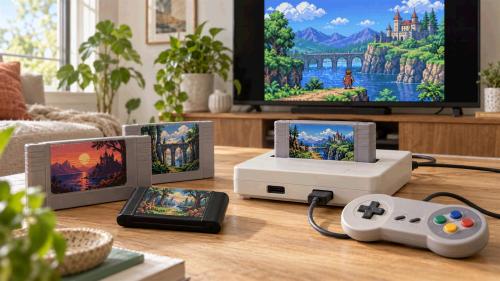
You still have the games. Perhaps you have had them for thirty years. The cartridges are on the shelf, but the console no longer works or is awkward to connect to your current television. Being able to use another device is welcome. The game itself does not need replacing.
We take that for granted with books: a broken reading lamp is no reason to buy the book again. With games, it is easy to confuse the content with the device that runs it. Yet that distinction matters. You want to keep playing your game, not remain dependent on that one console or a new release from the original publisher.
Devices that play existing cartridges directly offer one route. Analogue has announced the Mega Sg+ and Super Nt+ for Mega Drive and Super Nintendo games respectively. The cartridge someone already owns goes into a new player. No new digital copy of the game is being bought.
The game does not have to return to an online shop or subscription catalogue. Even when a publisher no longer offers it, a working copy can remain usable with suitable hardware.
That makes ownership tangible: you have something you can continue to use outside the seller's current catalogue. It does not mean you own the copyright to the game. It does mean that using your copy should not repeatedly depend on a new sales decision.
Continued use need not mean keeping everything exactly as it was. A good connection to a modern television can give old games a clearer, sharper picture. According to Analogue, these devices offer HDMI output up to 1080p. That can look better than an old analogue connection handled poorly by the TV, but it adds no new artwork or detail to the game.
The original game image is presented for a modern screen. Upscaling is not a remaster. Analogue lists aspect-ratio controls, filters and scanline settings for these devices, allowing different presentations.
Sharper is not automatically more attractive, either. Someone who likes the softer appearance of a CRT need not consider crisp pixels an improvement. Results depend on settings, screen and preference. The benefit is choice: keeping an old game playable in a way that suits you now.
Another player is useful, but it does not remove every dependency. New hardware can fail or go out of production too. Repair options, available firmware and understandable documentation therefore still matter. The more technical knowledge remains available, the more options there are for using a collection in the future.
The Analogue devices use an FPGA, configurable logic that recreates console hardware. That does not automatically make them open hardware or free software; the manufacturer states that these models do not support openFPGA. They are examples of an additional way to play, not complete independence.
Ultimately, your own game needs to work properly on it. A technical acronym or a promise of compatibility is no substitute for checking that.
Physical ownership needs care too. Contacts can cause problems, components age, and some cartridges use a battery to retain saved progress. New playback hardware does not repair a faulty game or recover a lost save. Preservation and repair still matter.
The crucial distinction is therefore not simply physical versus digital. It is a complete, locally usable copy versus access that remains dependent on an external service. A DRM-free digital release can be stronger in this respect than a disc that still needs a download or activation server.
That distinction also runs through our article on physical PC games and Right to Ownership. What makes these older cartridges interesting is that game and original console need not remain inseparable.
A re-release can be convenient. A remake can add something new. But neither should be the only route for someone who already has the original game. The ability to use that copy on different hardware deserves recognition in its own right.
If your old console still does what you need, nothing has to be replaced. But if that changes, repair or different hardware can offer a way forward. That matters beyond collecting: it also helps someone who simply wants to play an old favourite occasionally.
Someone who owns a game should not have to become a customer again to keep playing that same game. A new player can help. What matters most is what was already on the shelf.
Copyright © 2026, ASK-Solutions


