
 ,
,

 ,
,
 ,
,

Context: This article was originally published on April 5, 2024, shortly after Ubisoft had rendered The Crew unusable and Ross Scott had launched the Stop Killing Games campaign. The immediate event was specific, but the central question is broader and lasting: do you truly own a PC game when installation, activation or execution remains dependent on an account, launcher, activation server or server code that was never supplied? A physical disc can contain a complete, independently usable copy, but it can also be little more than a key to infrastructure controlled by the publisher.
After the original publication, Stop Destroying Videogames was registered as a European citizens' initiative on June 19, 2024 and signature collection began on July 31, 2024. In October 2024, United States DMCA exemptions for video game preservation remained limited. The European initiative closed on July 31, 2025, was submitted to the European Commission after verification on January 26, 2026 with 1,294,188 valid statements of support, and led to a public hearing and a debate in the European Parliament in 2026.
On June 16, 2026, the European Commission decided not to propose a legal obligation to maintain playability at that stage. It did announce discussions on an end-of-life code of conduct and further attention to existing consumer law. The ownership question therefore remains unresolved. Transparency, advance notice or a refund can limit harm, but they do not transfer lasting control over the paid product. The central test of this article remains: can you independently install, run, preserve and restore a lawfully acquired game when the original supplier disappears?
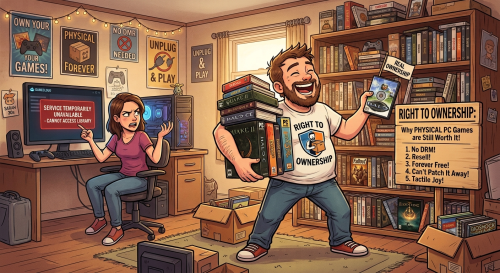
When you buy a PC game, what do you actually buy? A box, a disc, a licence, access to an account, or a product that you can continue to use without further permission?
That question is the core of Right to Ownership. Meaningful ownership does not mean that the buyer receives the copyright. It does mean that, after payment, the supplier should not retain permanent technical power to activate, alter, block access to or completely disable the product.
Physical PC games make the distinction tangible. A good physical release preserves software, documentation, design and a particular historical version. A box or disc is not, however, a guarantee of ownership. If the carrier merely provides access to a download, account, activation server or undistributed server code, the buyer mainly owns a key to infrastructure that somebody else can close.
With a traditional physical product, the seller's power largely ends at transfer. A publisher cannot remotely make a printed book unreadable. A manufacturer cannot disable a board game years later because a licensing agreement has expired. The owner can preserve, lend, resell, repair and use the product without requesting permission from the original seller every time.
For digital games, that relationship has been reversed. The user pays in advance, but continued use depends on systems fully controlled by the publisher, platform or an external service provider. An account must exist, an activation server must respond, a launcher must still work, DRM must approve the installation and, in some cases, part of the game must continuously be supplied by a server.
The purchase becomes a conditional ability to use. The consumer may have a box, disc, invoice and years of accumulated progress, while the publisher retains a technical veto. As long as that veto exists, ownership is primarily a marketing term.
The conflict between paying and genuinely owning became visible through The Crew, a 2014 racing game published by Ubisoft. Even its largely individual experience required a connection to publisher-operated servers. When those servers were shut down on 31 March 2024, lawfully purchased copies became unusable.
Shortly afterwards, Ross Scott of Accursed Farms launched the Stop Killing Games campaign. It does not demand that every official server operate forever. Its premise is narrower: when a publisher ends commercial support, a previously sold game should be left in a reasonably playable state. Depending on the design, that can be achieved through an offline mode, local authentication, self-hosted servers, publication of server software or another end-of-life solution designed in advance.
The campaign made visible a distinction that is often avoided: discontinuing a commercial service is not the same as deliberately leaving previously sold products unusable. A publisher need not continue providing new content, but design and sale should account for an end-of-life stage in which the buyer can independently continue using the existing game.
Whether a government ultimately chooses legislation, enforcement, consumer information or a code of conduct does not change the technical ownership test. As long as the supplier remains the only party capable of activating a paid copy or providing missing server functions, the product has not been durably transferred to the buyer.
Buying a game does not automatically transfer its copyright, trademarks or the right to exploit it commercially. The same is true for books, films and music. The author or publisher can retain intellectual-property rights while a buyer still owns a concrete copy.
The problem begins when copyright is used to exclude nearly every form of user control. The publisher then retains not only the exclusive right to put new copies on the market, but also the technical power to decide whether an already-paid copy can start, be repaired, be studied, be transferred or be disabled completely.
For ASK-Solutions, Right to Ownership therefore does not mean giving users all intellectual-property rights. It means that users can independently install, run, preserve, transfer where the law permits and, where necessary, restore a lawfully acquired copy without permanent permission from the original supplier.
Richard Stallman and the GNU Project define free software through four essential freedoms. This definition concerns liberty, not price. A program may be sold and still be free software, or be provided at no charge while remaining completely under the supplier's control.
Most commercial games were not free software even in the physical era. Their source code was not supplied, and licences generally did not permit free redistribution or publication of modified versions. Freedoms 1, 2 and 3 were therefore normally absent already. Online activation and server dependence then remove practical freedom 0 as well: even running one's own copy remains dependent on remote permission.
If necessary code, data or logic exists only on supplier-operated servers, the user does not even possess the complete program. In that situation, none of the four freedoms remains practically available. This does not mean that every commercial game must automatically become free software, but it does reveal how little control a so-called purchase actually transfers.
This is the most fundamental freedom. A program that starts only after an external activation server grants permission cannot be run independently by its user. The publisher decides on which systems, from which accounts, in which regions and until what date the program may operate.
When the server is shut down, no practical freedom 0 remains. The files may still exist on the disc and the computer may still be technically suitable, but the user is denied permission to start their own copy. The software behaves like a product with a remotely controlled master switch.
Access to source code is a prerequisite for this freedom. Proprietary games generally do not provide it. DRM, encryption, obfuscation and contractual restrictions make study and modification more difficult still.
Server dependence adds another barrier. If rules, artificial intelligence, parts of the world, authentication or other essential functions run on servers, users do not even possess the complete executable form of the program. It is impossible to study or restore what was never supplied.
A physical disc may be technically copyable, but licence terms, account binding, unique keys and DRM prevent a lawful copy from being transferred independently. Even after a game is no longer sold and the publisher no longer provides a functioning service, distribution will usually remain prohibited or technically useless.
A community therefore cannot simply keep an abandoned game alive. Users are not permitted to solve the lack of availability by preserving and sharing existing files, even when nobody can purchase a new copy.
This freedom is essential for maintenance. When the original supplier stops, a community can repair bugs, restore compatibility with new operating systems, replace an authentication server or add an offline mode.
Closed games normally provide neither the source code nor legal permission. If technological protection measures must also be bypassed, anti-circumvention law may create an additional obstacle. A community may have the technical knowledge to save the game but lack a safe legal route to develop and distribute the result.
With older PC games, nearly the entire game ran from locally supplied data. An online connection could add functionality, but the core continued to operate on the player's computer. In modern games, the local installation may be only a client. Essential code, configuration, game state, scripts, worlds or calculations may reside on supplier-controlled servers.
This distinction is crucial. If the disc contains all copyrighted content and the server performs only an unnecessary activation check, removing that check may restore the game. If required game code existed only on the server, the sold copy is structurally incomplete. After shutdown, more than permission is missing: part of the product has disappeared.
The user can then do nothing with the game itself. No activation means no play. No download means no installation. No server code means no replacement server. A physical box does not change this.
Section 1201 of the United States Digital Millennium Copyright Act prohibits circumvention of technological measures controlling access to copyrighted works. It also restricts the creation and distribution of tools primarily intended for such circumvention. Breaking an abandoned activation check can therefore become a separate legal issue even when the underlying use of a lawfully acquired copy would not itself infringe copyright.
Temporary exemptions exist and are reconsidered every three years. Recent cycles have provided narrowly conditioned room to modify a lawfully acquired, complete game for personal, local play after a necessary authentication server has ceased to operate. The precise scope may change from one cycle to the next, but the structural limitation remains: an exemption from an anti-circumvention prohibition is not a general ownership right.
Libraries, archives and museums have broader preservation possibilities, including cases in which former server code is available. Access to preserved games remains severely restricted and is generally tied to the institution and its physical premises. This illustrates the difference between being allowed to preserve software as a special exception and being allowed to continue using a product normally because it was lawfully purchased.
The DMCA is United States law, but its effects are international. Many publishers, hosting providers, platforms, development tools and preservation projects operate in or through the United States. Legal risk surrounding the publication of patches, keys, server emulators or circumvention tools can therefore affect users and researchers elsewhere.
A game is not a static document that merely needs to be copied. It is a combination of code, data, interaction, operating system, hardware, middleware, network protocols and sometimes external services. Preservation requires the complete system to remain executable.
In 2023, the Video Game History Foundation concluded that approximately 87% of the classic games in its study, released in the United States before 2010, were no longer commercially available. For these titles, second-hand physical copies, old hardware, emulation and legally uncertain copies are often the only remaining forms of access.
Physical releases are therefore important for cultural preservation. They can preserve a particular version later replaced by patches, remasters or storefront updates. They preserve documentation and artwork omitted from digital stores. A disc can only function as a useful archive, however, when its contents are sufficiently complete to reconstruct and execute the game independently.
Despite these limitations, a good physical release remains valuable. It can reduce several forms of dependence:
Its value is therefore not merely nostalgia or collector pricing. A good physical release is documentation, distribution medium and archive at the same time. The word physical, however, is not a quality guarantee. An empty box containing a download code, a disc containing only a launcher or an installer that must contact a vanished server provides scarcely more autonomy than a disappeared digital download.
Anyone buying physical PC games for genuine ownership or preservation should inspect their technical properties rather than only their packaging:
A simple notice stating “internet connection required” is not enough. Consumers should know why a connection is required, which functions will disappear if the service ends and whether the game's core will remain usable.
The debate directly connects to Right to Repair. For hardware, the relevant issues include parts, documentation, diagnostic tools and the ability to restore a device without exclusive manufacturer permission. For software, they include installation media, source code or sufficient technical information, authentication, protocols, keys and the ability to replace necessary services.
A broken activation server is functionally a defective component. A vanished download is an unavailable spare part. A secret protocol preventing private servers resembles an undocumented diagnostic port. A legal prohibition on removing abandoned DRM can make repair impossible after the supplier itself no longer repairs anything.
Game preservation is therefore not merely a matter of nostalgia or copyright. It concerns ownership, repair and the question of who ultimately controls a product that has already been paid for.
Publishers do not have to be forced to pay for servers forever, retain staff indefinitely or continue making new content. A responsible end-of-life plan can be designed during development and activated only when the commercial service ends.
Depending on the game, such a plan may include:
No single solution fits every game. A competitive online world, a small cooperative title and a single-player game with online-only DRM have different technical requirements. Those differences do not justify having no plan at all. The components dependent on central infrastructure are known during development.
An old game box remains a time capsule. Physical PC games are worthwhile because they preserve something an account library cannot replace: a tangible copy, a historical version and the context surrounding the game. Wear, stickers, manuals and even obsolete support telephone numbers reveal how games were once made, sold and played.
Meaningful ownership does not begin with cardboard. It begins with the ability to install, run, preserve and restore the game without renewed permission. When a publisher can remotely disable the last working copies, the user owns little more than a carrier and a revocable promise.
The four freedoms reveal how extensive that control has become. With closed software, studying, modifying and sharing were generally already excluded. Always-online DRM and missing server code then remove the most basic freedom as well: running the program. Stop Killing Games attempts to restore precisely that minimum. It does not seek the creator's copyright, but aims to prevent a paid cultural work from disappearing through a single switch.
A physical release is therefore most valuable when it is more than packaging: a complete, independently usable copy without a permanent technical veto held by the supplier.
The European Commission registered Stop Destroying Videogames on June 19, 2024. On July 31, the period began in which European Union citizens could support the initiative. It called for rules preventing publishers from remotely disabling sold or licensed games without providing a reasonable means for them to continue functioning.
The wording was deliberately limited. The initiative did not ask for a transfer of copyright, trademarks or monetisation rights, or for official servers to be funded forever. It asked for an end-of-life state in which the publisher is no longer necessary for the basic operation of a game already sold.
That distinction directly concerns Right to Ownership. A supplier may end a commercial service, but that need not mean technically destroying every copy held by customers. Offline use, local authentication, self-hostable server software or network-protocol documentation can end the service without taking away the product itself.
In the United States triennial review of DMCA Section 1201, exemptions for abandoned video games and preservation by libraries, archives and museums remained in place, but their scope remained limited. The Video Game History Foundation had asked for preserved games to be made remotely accessible to researchers. That request was not granted.
The fundamental distinction between ownership and a special exemption therefore remained. An institution may circumvent technical protection under narrowly defined conditions to preserve a game, but this does not create a general right to keep the work normally accessible. For individual purchasers, publishing and distributing necessary circumvention tools or replacement servers remains legally risky.
European signature collection closed on July 31, 2025. Following verification by the Member States, the initiative was submitted to the European Commission on January 26, 2026 with 1,294,188 verified statements of support. It became the fourteenth valid European citizens' initiative to reach the required thresholds and require formal consideration by the Commission.
The number of supporters shows that this is not only about nostalgia or a small group of collectors. Many users consider it unacceptable for a purchase to be remotely destroyed while the purchaser retains local files, a physical disc, an invoice and sometimes years of progress. The ownership problem exists precisely because all those physical and digital remains can be made useless without the publisher's permission.
The organisers presented the initiative at a public European Parliament hearing on April 16, 2026. A plenary debate followed on May 21. The central point remained that the initiative did not demand eternal commercial support, but an end-of-life state designed in advance in which future games remain reasonably playable after the service ends.
On June 16, 2026, the European Commission replied that it did not intend at that stage to propose a legal obligation to keep video games playable after they cease to be commercially available. It referred among other matters to proportionality, copyright, existing consumer rules and the varied technical characteristics of games. It did, however, announce discussions with industry and consumer representatives by the end of 2026 on a code of conduct for managing the end of a game's life.
That response recognises the problem but does not yet give the purchaser a Right to Ownership. A pre-purchase warning, clear licence terms or a possible refund mainly explains the conditions under which access may disappear. It does not transfer missing code, remove an activation check or let users restore the game independently.
The developments after the original publication therefore confirm its central conclusion. A physical or digital copy becomes durable possession only when its core can continue functioning without the supplier's continuing technical permission. As long as one external party can disable every copy, the purchaser remains dependent on a revocable promise rather than owning an independently usable product.
Copyright © 2026, ASK-Solutions


