
 ,
,

 ,
,
 ,
,

Context: Streaming services made films and series easier to watch, but also easier to lose. A DVD, Blu-ray or local copy remained in the home. A streaming title sits in a library that can change because of contracts, regions, mergers, tax choices, subscription tiers and platform strategy. The question is therefore not only where something can be watched today, but who decides whether it remains available to the public tomorrow.
This article continues our earlier piece Right to Ownership: why physical PC games are still worth it. For games, the debate often concerns activation servers and missing server code. For films and series, the same ownership question concerns licences, closed apps, disappearing catalogues and purchases that legally or technically resemble access more than possession.
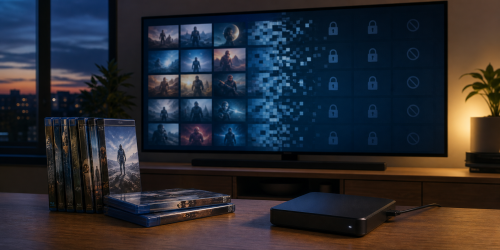
Streaming feels abundant. A search box, a remote control, thousands of titles and no shelf full of discs. For everyday convenience, that is attractive. The problem begins when convenience is mistaken for ownership.
When you watch a film or series through a streaming platform, you usually do not use an independent product. You receive access to a service. That access depends on an account, an app, a region, a subscription, a device, an internet connection and, above all, contracts between companies. If one of those links changes, a title can disappear without anything changing on the viewer's side.
Right to Ownership does not mean that a viewer receives the copyright to a film or series. It does mean that a lawfully acquired copy should not remain entirely under the remote control of a platform. A paid collection should be more than a list of promises in an account.
For many people, streaming began as a simpler alternative to cable television, downloads and physical rental. A few services offered broad catalogues for a relatively understandable monthly fee. At that stage, streaming looked almost like a universal video store.
Then the market changed. Studios and platforms built their own services, existing licences expired and exclusivity became a tool for retaining subscribers. Films and series did not merely go online; they began to hop between platforms. What was on one service yesterday may be on another tomorrow, disappear temporarily, return inside a more expensive bundle or be available only in another country.
For the viewer, access becomes fragmented. Following one series can require several subscriptions. A film series can be split across different services. A title that once helped justify a subscription can later disappear while the monthly charge continues.
That is not an incident, but a logical result of the model. A streaming subscription does not sell a library. It sells temporary access to a changing selection.
A common assumption is that platform-owned productions are safer than licensed titles. If a service made the series itself, why would it ever disappear?
In practice, that is not a hard guarantee either. A platform can remove its own productions because strategy changes, because a merger reshapes the accounts, because residuals and hosting costs become unattractive, because a title no longer fits the brand or because writing it down is financially preferable to keeping it available.
For the viewer, the reason often changes little. The series was in the app yesterday and is gone today. Sometimes it appears elsewhere later. Sometimes there is a physical release. Sometimes only a trailer, a review, a wiki page or a discussion remains. Anyone who wants to watch the work itself to judge its cultural value, quality or criticism may have nowhere to go.
That is especially troubling for controversial or heavily criticised works. Criticism should be verifiable. Public debate about a film or series becomes weaker when the object of criticism disappears. What remains is reputation, not the work itself.
The problem is not limited to subscriptions. Digital purchases from video services often transfer less ownership than the word "buy" suggests. Terms usually state that purchased content will generally remain available, but may disappear because of licensing restrictions, loss of rights or other reasons. Some platforms therefore encourage users to download and back up purchased content where possible.
That is an important admission. If a purchase remains dependent on the platform for redownloading, playback or authorisation, the user is not in the same position as with physical media. A DVD can be damaged or misplaced, but the publisher does not need to approve playback online. A digital purchase in a closed account, by contrast, can disappear because of a contract or technical decision outside the user's control.
The difference is therefore not nostalgia versus progress. The difference is control. A physical disc is not perfect, but it is a more independent object. A streaming library is convenient, but it remains a service.
Streaming platforms are designed for current consumption, not cultural preservation. They optimise for subscriber growth, viewing time, recommendations, costs, rights and brand value. Those are understandable business goals, but they are not archival goals.
An archive tries to preserve versions, retain context and make access possible even when a work becomes less commercially interesting. A platform tries to show an attractive offer within the limits of current contracts and strategy. These goals sometimes overlap, but they are not the same.
That is why "it is online now" is not a durable answer. A film may be available today in a censored or altered version, disappear tomorrow because of rights, return later with different subtitles and never again appear in its original cut. Without an independent copy, there is no stable reference point.
For films and series, Right to Ownership does not have to mean that every streaming service must offer every title forever. A platform must be able to end a service, let rights expire and change a catalogue. The question is what happens to works sold to consumers or made culturally dependent on a closed platform.
A workable ownership standard could begin with a few simple principles:
Not every title can be treated in the same way. Rights chains are complex, music licences expire and some productions are costly to reissue. Complexity, however, is not a reason to use ownership language while giving the user only a conditional stream.
Consumers cannot solve the system alone, but they can choose more deliberately. If a film or series truly matters, a streaming link should not be treated as enough. A physical release, a DRM-free download or a local backup where law and terms permit provides more durability than a title in an app.
Pay attention to the words platforms use. "Included with your subscription" means temporary. "Buy" may still mean a licence. "Download" may mean an offline cache that expires. "Original" does not automatically mean permanently available. And "exclusive" usually means, above all, that you cannot go elsewhere.
For companies, schools, libraries and researchers, that caution matters even more. A reference to a streaming title is not an archive strategy. Anyone who needs a work for education, research, criticism or documentation needs a more stable form of access than a platform catalogue.
Streaming is not bad because it is streaming. It is fast, accessible and excellent for many uses. The problem begins when all other forms of access disappear and the service becomes the only gatekeeper.
If a film or series exists only as long as a platform chooses to keep it in the catalogue, culture is fragile. If a purchase works only as long as an account and licence server cooperate, ownership is mostly an interface word. And if a criticised work disappears before people can judge it for themselves, public debate becomes dependent on the preservation choices of private platforms.
Right to Ownership therefore asks for a simple shift: call access access, call ownership ownership, and design digital distribution so lawfully acquired works do not disappear when a platform, contract or strategy changes. Films and series are more than monthly retention content. They are culture, memory, debate and history. That deserves a form of availability that lasts longer than the next catalogue cycle.
| Amazon Prime Video | Terms | Prime Video Terms of Use: availability of purchased digital content |
| Apple | Terms | Apple Media Services Terms and Conditions: purchased content and downloads |
| Netflix Help Center | Current explanation | Netflix content varies by region and may change over time |
| The Walt Disney Company | May 10, 2023 | Form 10-Q: review and removal of certain DTC content |
| Warner Bros. Discovery | 2022 | Annual Report: content impairments and strategic realignment |
Copyright © 2026, ASK-Solutions


