
 ,
,

 ,
,
 ,
,

Context: According to a court filing unsealed on July 20, 2026, the Trump administration sought phone records of several New York Times journalists and some of their relatives, including one reporter's mother.
The reported purpose was to identify confidential sources for articles about the security capabilities of a Qatar-gifted Boeing 747-8 discussed as President Trump's new Air Force One jet.
This article is not about whether leaks of state secrets may never be investigated. Of course a government may investigate real national security risks.
The question is whether it may use the press, its sources and even journalists' relatives as a dragnet. That is where it becomes a serious First Amendment problem.
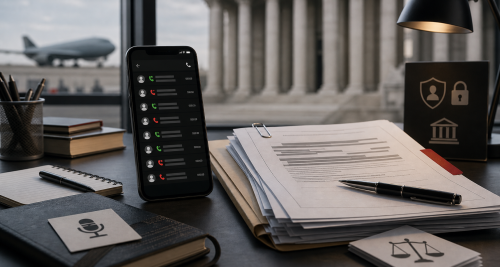
Phone records sound technical and harmless. No recording of the call, no transcript, no secret microphone in the lamp. Just metadata: who called whom, when, for how long, and sometimes through which service or location context.
But metadata can already reveal enough. It is not a recording, but it is not an empty envelope either. In journalism, a calling pattern may be enough to identify a source. If a reporter calls a government employee, then an editor, then that employee again, and an article appears shortly afterward, nobody needs the content of the conversation to see the route.
That is why demands for journalists' phone records are so sensitive. Demands for relatives' records are more sensitive still. A source might try to avoid direct contact with a journalist and use another number.
But a family circle is not a constitutional service entrance for the state. A source investigation should not become a shortcut through the family group chat. A reporter's mother should not suddenly become an extension of a leak investigation because the government wants to draw the newsroom from the outside.
The core facts are these. The New York Times published articles about security concerns surrounding a Qatar-gifted Boeing 747-8 that President Trump presented as a temporary new Air Force One aircraft. The reporting raised questions about defensive systems and secure communications.
Multiple Times journalists were then served with grand jury subpoenas. According to AP and CBS News, the government also sought phone records of journalists and relatives, including one reporter's mother and two spouses.
The Times asked a judge to quash the subpoenas, arguing that the steps were intimidating, retaliatory and inconsistent with press freedom and DOJ policy. The government argued that it was investigating alleged leakers, not targeting journalists.
That distinction sounds tidy. On paper, almost everything is tidy; paper is very good at that. In practice, a source investigation that forces reporters to expose sources or reveals their calling network can directly interfere with the journalistic function.
The First Amendment protects freedom of speech and freedom of the press. That protection is not constitutional wallpaper, a historical postage stamp or a polite request that government stay nice to newsrooms. It exists because democratic oversight becomes impossible when the state can determine which information about the state reaches the public sphere.
Press freedom protects more than the final act of publication. It also protects the process that makes publication possible: searching, asking, verifying, weighing, publishing and accounting for the work. Confidential sources are sometimes essential to that process.
Without source protection, what remains is mainly what government wants to say and what someone is brave enough to leak without protection. That produces a narrower, more cautious and less verifiable news supply.
When the government seeks phone records of journalists and their surrounding contacts to identify sources, it creates a chilling effect. Sources learn that contact with a journalist may pull not only themselves, but also people around the journalist, into an investigation. The rational reaction is silence. And silence is usually very comfortable for power.
No serious press freedom argument says national security is irrelevant. If someone leaks secret operational details that endanger lives, the government may and should investigate. But "national security" is not a universal pass for whatever is convenient. It is a reason for care, not a reason to skip it.
Especially in national security matters, the temptation toward overreach is strong. Government has information, authority and often a powerful incentive to label embarrassing or damaging reporting as dangerous. Sometimes that concern is real. Sometimes it is merely convenient.
That is why DOJ rules exist for obtaining information from or about members of the news media. Current federal regulations describe such tools as extraordinary measures, not standard investigatory practices. That matters. A subpoena aimed at a journalist is not an ordinary administrative fishing line in a data pond; it is an instrument touching the nerve of press freedom.
That may be the most important question. Was there truly a concrete national security problem caused by the publication, or was "national security" being used to pursue a personal or political score against critical reporting?
The honest answer is: from the outside, one cannot prove the administration's inner motivation. What can be tested is whether the national security claim is convincing. Did the reporting reveal specific, still-secret operational information? Was the leak investigation narrow enough? Had less intrusive methods been tried? And why did relatives' records need to be involved?
That last point is where the security argument weakens. The articles concerned whether a presidential aircraft was secure enough and what risks existed around it. That is plainly a matter of public interest. If the government then reaches not only for journalists, but also for relatives' phone records, the action begins to look less like protecting a specific secret and more like applying pressure to find sources.
There may have been a real security concern. But a real security concern is not a blank cheque for an overbroad investigation. Precisely then, the government must show that its tools are necessary, targeted and proportionate. Otherwise "national security" becomes a convenient label for something that, in ordinary language, looks a lot like intimidation.
The most striking part is not only that journalists themselves were targeted. It is that, according to the reporting, the government also sought records of family members. That changes the pressure.
A journalist knows investigative work has risks. Relatives did not sign up for that. A mother, spouse or other close contact may have confidential professional or personal relationships entirely unrelated to the publication. If the government uses those records to work around journalistic protection, the circle of intimidation expands beyond the newsroom.
That is exactly why this is not merely an internal fight between a newspaper and an administration. It affects anyone who may one day need wrongdoing to come to light without every communication path around a journalist being emptied onto the table.
Source protection is sometimes described as a luxury for journalists. That is wrong. It primarily protects the public.
A source reporting corruption, failed security policy, abuse of power or technical insecurity often takes personal risk. Sometimes the source is angry, sometimes principled, sometimes afraid, sometimes all three before lunch. The journalistic task is not to believe every source automatically, but to verify information and publish facts of public importance.
If every sensitive story can produce an effort to collect phone records of journalists and relatives, the price of speaking rises. Not only for spies or criminals, but also for whistleblowers, troubled officials and employees who see that an official story does not match reality.
A First Amendment attack does not always look like an explicit publication ban. The government need not say: "you may not publish this article." It can punish afterward, intimidate, or signal that certain reporting will have personal consequences. That can be just as effective.
It is therefore too narrow to ask only whether the Times was ultimately allowed to publish. The better question is whether the government's conduct makes it reasonably more dangerous for journalists and sources to scrutinize the administration. If the answer is yes, press freedom is affected even without a classic censorship stamp.
The First Amendment does not protect a comfortable press. It protects a difficult press. A press that asks questions about aircraft, contracts, security systems, gift arrangements and government decisions. Those are exactly the questions an administration may prefer to avoid.
The government may investigate leaks. It may collect evidence. It may take national security risks seriously. But it must apply a high threshold when an investigation may expose journalistic sources.
That boundary should include at least three questions. Is the information truly essential to a concrete, serious investigation? Have less intrusive means been exhausted? Is the request narrow enough not to produce a map of journalistic contacts, family communications or source relationships?
In this case, the concern lies precisely in the breadth. Seeking phone records of relatives does not look narrow or targeted. It may find something useful, but it also pulls in records that should never have needed to enter the investigation.
The First Amendment question is ultimately not whether one likes the New York Times, or the journalists, or the president, or Qatar, or the aircraft. A constitutional right has meaning precisely because it also applies to parties one may find unsympathetic, difficult or politically inconvenient.
The question is whether an administration may use criminal investigative tools to unmask confidential sources for critical reporting, including through relatives' records. If that becomes normal, the space for investigative journalism shrinks. Sources grow quieter, newsrooms more cautious and people in power more comfortable.
That is exactly why this should be understood as an attack on the First Amendment. Not because journalists stand above the law, but because the law must not be used as a workaround to hollow out the press function. A free press is not a favour to newsrooms. It is public infrastructure for democratic oversight.
When source protection is weakened, that democratic infrastructure is weakened with it. Not only for one newspaper or one investigation, but for everyone who depends on a press able to scrutinize power without first asking power for permission.
| Associated Press | July 20, 2026 | Officials sought phone records of NYT journalists and their relatives in an effort to unmask sources |
| CBS News | July 20, 2026 | New York Times moves to quash subpoenas for phone records of reporters and family members |
| Associated Press | July 15, 2026 | New York Times reporters are subpoenaed after Air Force One stories, raising press freedom concerns |
| National Archives | Bill of Rights transcript | Bill of Rights transcript: First Amendment text |
| eCFR | Current regulation | 28 CFR § 50.10: policy on obtaining information from or records of members of the news media |
| Reporters Committee for Freedom of the Press | 2025 analysis | Analysis of DOJ changes to news media guidelines |
Copyright © 2026, ASK-Solutions


