
 ,
,

 ,
,
 ,
,

Context: In March 2024, Oregon Governor Tina Kotek signed SB 1596, a Right to Repair law for consumer electronics. The law goes into effect from 2025 and is notable because it does not only address manuals, parts and tools, but also parts pairing.
Parts pairing means that a device uses software to check whether a part has been approved, paired or activated by the manufacturer. A display, battery, camera, sensor or circuit board may physically fit and technically work, but still be limited because the software does not accept the repair as "official".
This article looks at why Oregon is an important Right to Repair milestone, and why the modern repair debate is less and less about screws and more and more about permission.
 Follow our fight for Right to Repair
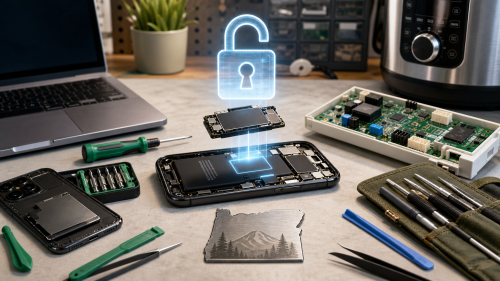
Right to Repair began for many people as a simple idea: if you buy something, you should also be able to have it repaired. Not only by the manufacturer, not only inside a closed dealer network, and not only as long as an online portal feels cooperative.
But modern devices have gained an extra layer. The question is no longer only whether you can buy the right part, or remove a screw without first calling a secret society. The question is also whether the software will still treat the repaired device as a full device afterwards.
That is why Oregon matters. The state did not only say that manufacturers must make repair information and parts available. Oregon also looked at parts pairing: the mechanism by which software can identify, limit, warn about or reject components.
Parts pairing sounds technical, but the principle is simple. A device checks whether a component has a certain digital identity. If that identity does not match what the manufacturer expects, the device can limit functions, show warnings or make the repair work less well.
Sometimes that happens for a safety reason. A battery must be safe. A fingerprint sensor should not be replaced by something that undermines biometric security. A device with medical or critical functions deserves more caution than a toaster with a dramatic sense of importance.
The problem starts when that argument is used more broadly than necessary. Then parts pairing changes from a safety check into an economic fence. The part fits, the repair is technically possible, but the software makes clear that the owner does not get the final say.
Many Right to Repair laws focus on documentation, parts, tools and diagnostic information. That is important, but it is not enough when the block lives in software.
Oregon SB 1596 therefore goes further. Within the scope of the law, it prohibits manufacturers from using parts pairing in a way that prevents or unnecessarily limits independent repair. Warning messages that mainly scare the user away from a working replacement part also become part of the regulatory discussion.
That makes Oregon high-profile. Not because it is the first Right to Repair law ever, but because it is one of the clearest attempts to address the modern software problem in repair. New York opened a door. Oregon checks whether there is still a smart doorbell behind it that only opens with manufacturer approval.
The honest answer is that not every reason is nonsense. Manufacturers want to protect quality, limit warranty claims, keep dangerous parts out and defend security. Those are real interests.
A device full of lithium-ion batteries, sensors, wireless connections and personal data is not a wooden chair. Bad parts can cause damage. Bad repair can be dangerous. And yes, some counterfeit parts are genuinely rubbish with a QR code and confidence.
But real safety interests do not justify general manufacturer control over every repair. There is a difference between a necessary check and a system that structurally makes independent repair unattractive.
If a part is safe and functional, the owner should not depend on a manufacturer server to learn whether the repair is morally acceptable. You buy a device, not a subscription to permission.
Parts pairing shows why Right to Repair is also about ownership. Ownership is not only having a device physically in your hand. It also means having reasonable control over it after you paid for it.
When a manufacturer uses software to decide which parts may work, who may perform the repair and which warnings the user sees afterwards, that control shifts. The device may be on your desk, but part of the power remains with the manufacturer.
That is especially problematic because many devices can remain useful for much longer than their official service channel. A phone can serve well after a new battery. A laptop can last years longer with a replacement screen or keyboard. A household appliance may continue with a small board or sensor replaced.
If software blocks that repair, the waste does not come from technical necessity, but from control.
Oregon is only one state, but large manufacturers rarely build a completely different device for every jurisdiction. If a company must adjust parts, documentation and software procedures for Oregon, the effect can reach beyond the state border.
We have seen that before with other consumer laws. Large markets and clear rules can shift design choices worldwide. Sometimes because manufacturers legally must. Sometimes because it is cheaper to apply a better standard broadly than to manage local exceptions everywhere.
That makes Oregon important for anyone asking where Right to Repair is going. The fight is moving from "may I open the device?" to "may the device still work normally after repair?"
Oregon does not solve everything. The law has exceptions, definitions and effective dates. Not every device is covered, and not every form of software control is automatically banned.
That is not surprising. Legislation is rarely a big red button labelled "make everything reasonable", although that would occasionally be refreshing. In practice, it is about boundaries: which products, which parts, which manufacturers, which duties and which safety exceptions.
Still, the direction matters. Oregon recognizes that repair can be blocked not only by missing screwdrivers or secret manuals, but also by software that can downgrade a working replacement part to a second-class citizen inside its own device.
For ASK-Solutions, this subject fits the same line as our earlier articles about John Deere, New York, software ownership and digital collections. The same question keeps returning: what does ownership still mean when access, function and repair depend on a supplier?
With tractors, the issue is diagnosis and work at the right moment. With phones and laptops, it is affordable repair and less electronic waste. With games, e-books and media, it is access to something already paid for. The form changes, but the pattern is familiar.
Oregon is therefore more than a U.S. state with a tidy legal text. It is a signal that Right to Repair is growing up. Not only parts and manuals must be available; software must also stop getting in the way without a good reason.
A part that fits, works safely and restores the device should not have to send a permission slip to the manufacturer. That is the core. Repair should become a normal act of ownership again, not a favor handed out by software.
| Oregon State Legislature | 2024 | SB 1596: Right to Repair measure overview |
| Oregon Legislative Assembly | 2024 | Enrolled Senate Bill 1596 |
| Federal Trade Commission | February 26, 2024 | FTC staff letter on Oregon SB 1596A and parts pairing |
| Oregon Senate Democrats | March 27, 2024 | Governor Kotek signs strongest Right to Repair law in the nation |
| iFixit | March 5, 2024 | Oregon struck a blow to parts pairing and won repair support |
| The Verge | March 27, 2024 | Oregon governor signs right-to-repair law banning parts pairing |
Copyright © 2026, ASK-Solutions


